
PayPal and Klarna: two more routes, each with its own rulebook
PayPal disputes run under PayPal’s UK policy, and Klarna now sits under FCA rules for Buy Now Pay Later. Both meet Hipobuy’s own rules on the way.
PayPal clocks
Buyer Protection’s two claim types and their clocks
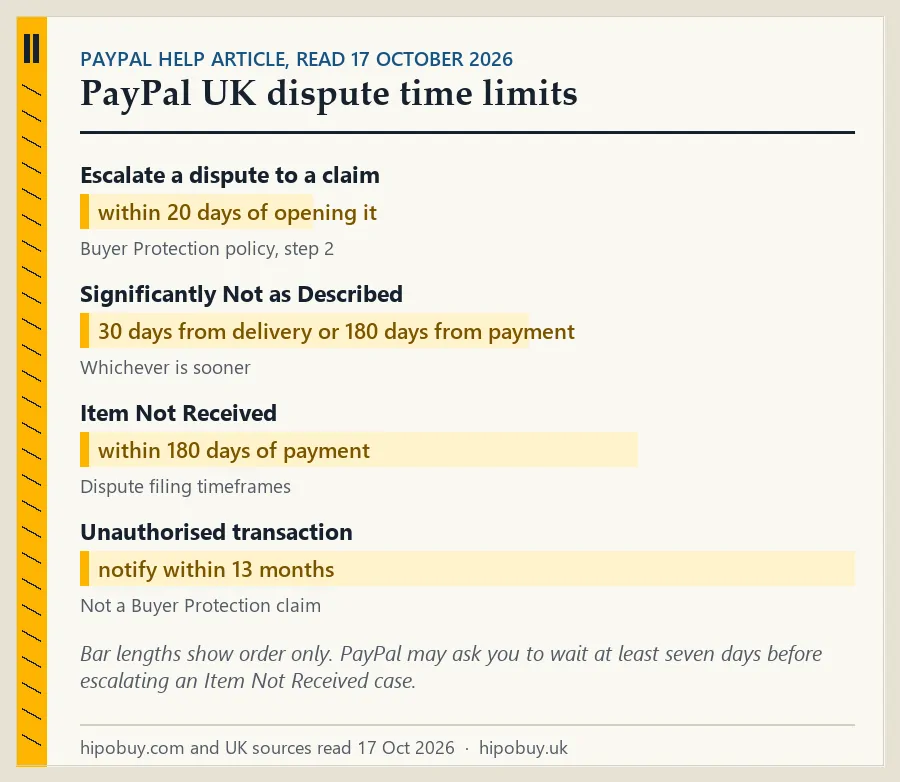
PayPal’s UK Buyer Protection policy, last updated on 12 October 2026, covers two problems: an item you did not receive, and an item that is significantly not as described.
Its help article gives the time limits. An Item Not Received dispute must be opened within 180 days of the payment. A Significantly Not as Described dispute must be opened within 30 days of delivery or 180 days of payment, whichever comes sooner.
Opening is only the first step. If you and the seller cannot agree, you have 20 days to escalate the dispute to a claim, or PayPal closes it automatically. For Item Not Received cases, PayPal may ask you to wait at least seven days from opening before escalating.
Eligibility
Stored value, and why a top-up is an open question
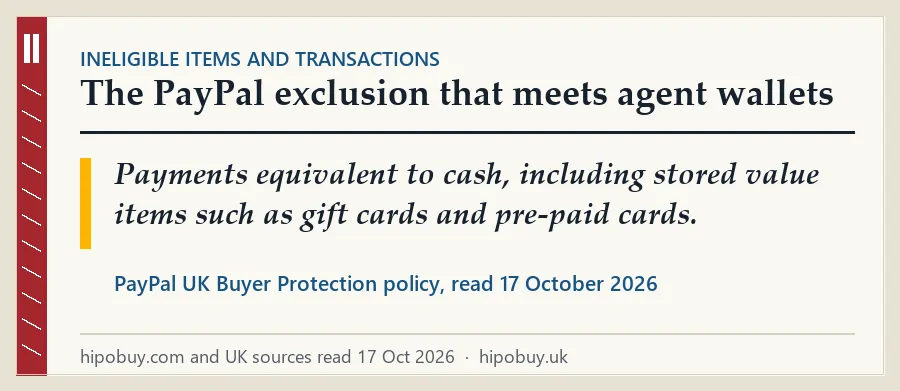
PayPal’s policy lists items and transactions that are not eligible for Buyer Protection. Most are obvious: property, vehicles, investments. One line matters for agent users: “payments equivalent to cash, including stored value items such as gift cards and pre-paid cards.”
A Hipobuy wallet top-up turns PayPal money into a balance you spend later. Whether PayPal treats that as stored value is PayPal’s decision, and nothing on its pages names agent wallets either way. A payment made directly for an order or a shipping fee is a different kind of transaction from a top-up.
The same policy lists the basic conditions: an account in good standing, payment for the item from your PayPal account, an attempt to resolve it with the seller first, and a dispute opened within the time limit.
Sequence
A PayPal claim or a card claim, not both at once
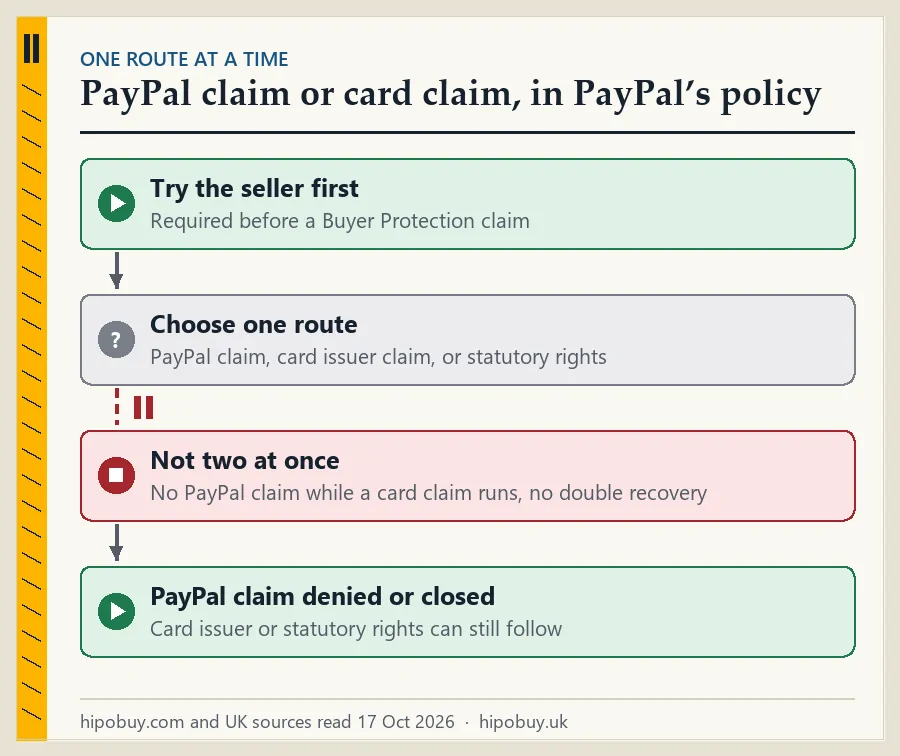
If a card funded your PayPal payment, PayPal’s policy says you may be entitled to dispute the transaction with your card issuer instead, and that card chargeback rights “may be broader” than Buyer Protection.
It is firm about sequence. You cannot make a Buyer Protection claim at the same time as a claim with your card issuer, or seek a double recovery. Choosing a PayPal claim first does not stop you relying on card issuer rights later if PayPal denies or closes it.
While a dispute is open, the policy says PayPal places a hold on all funds related to the transaction in the seller’s PayPal account until it is resolved or closed. So a PayPal dispute holds money at both ends: at PayPal on the merchant side, and at Hipobuy through the account lock.
How Hipobuy handles PayPal
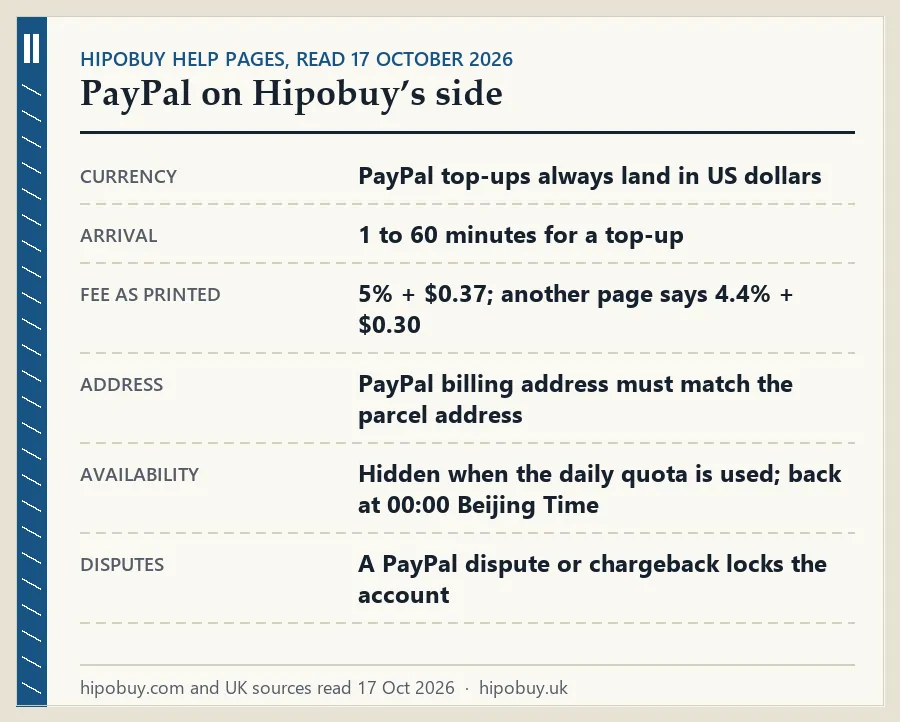
Hipobuy treats PayPal as both a top-up route and a checkout option. Money topped up through PayPal arrives in US dollars and can take up to an hour.
Two Hipobuy rules touch PayPal disputes directly. The lock article names PayPal disputes and chargebacks as a cause of an automatic account lock. And the PayPal article says the shipping address on PayPal’s billing page must match the address given to Hipobuy when you submit the parcel, which is one of the details any later Item Not Received dispute will look at.
When a combined payment of gold coins and PayPal is refunded, Hipobuy returns the PayPal part as wallet balance rather than to PayPal. Getting it back to PayPal then means a withdrawal.
Klarna at Hipobuy
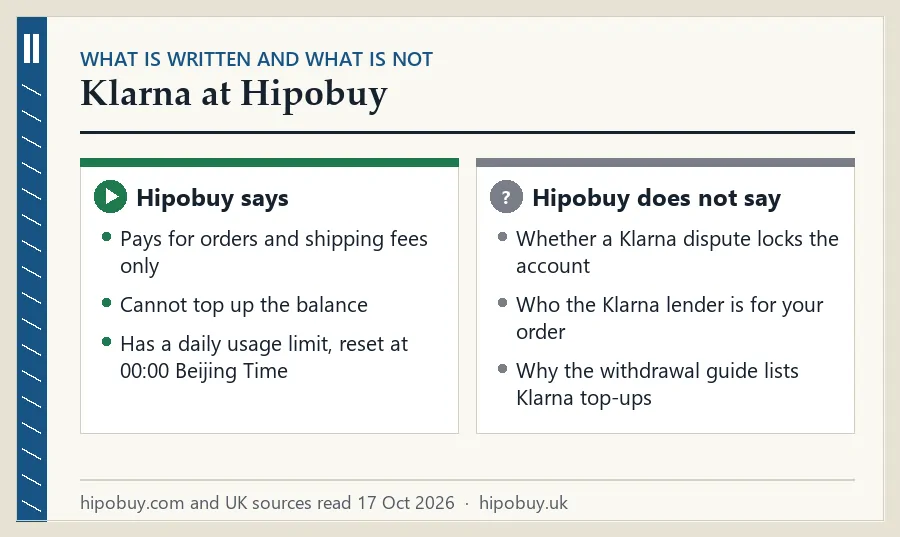
Hipobuy’s notice on Klarna is three lines long. Klarna pays for orders and shipping fees directly; it cannot top up the wallet; and it stops for the day once a daily cap is reached, starting again at 00:00 Beijing Time.
What the notice leaves out matters as much. The lock article names PayPal and credit card disputes but not Klarna, so the effect of a Klarna dispute on a Hipobuy account is not written down. And Hipobuy’s withdrawal guide lists Klarna among the channels whose top-up records appear on the withdrawal page, which sits oddly beside the no-top-ups rule.
Klarna’s own terms decide who the lender is and how its disputes work. That is the agreement the FCA rules below apply to.
Buy Now Pay Later under FCA rules since July
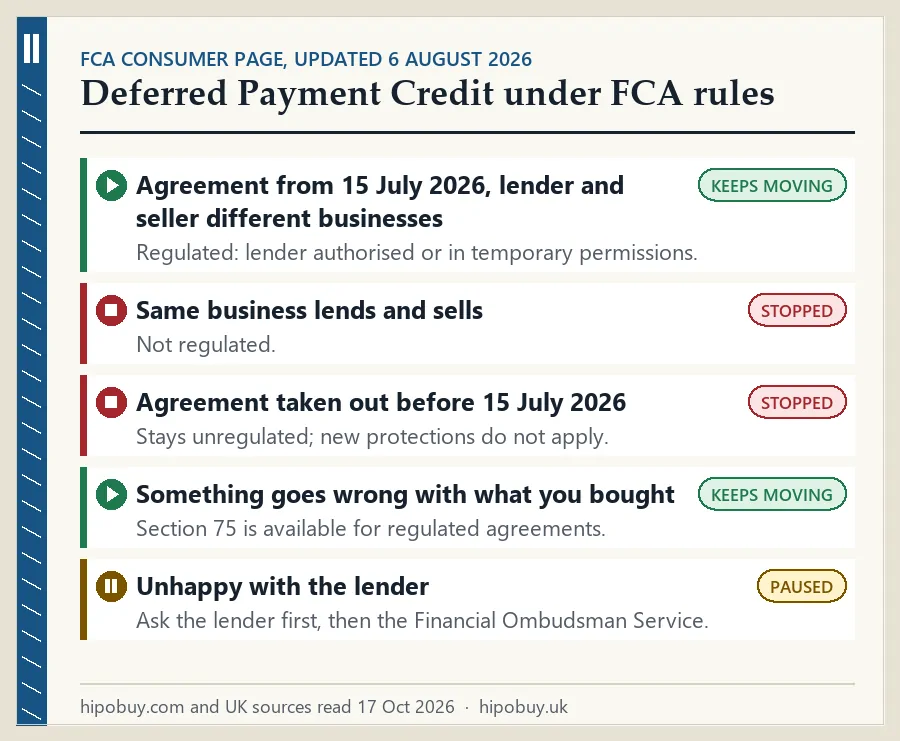
The FCA started regulating Deferred Payment Credit, “often known as Buy Now Pay Later”, on 15 July 2026. It defines it as interest-free credit repayable in 12 or fewer instalments over 12 months or less.
An agreement is regulated if the lender and the supplier are different businesses. If the same business lends and sells, it is not. Any agreement taken out before 15 July 2026 stays unregulated, and the new protections do not apply to it. Lenders must be authorised by the FCA or be in its temporary permissions regime, and the FCA Firm Checker shows which.
For regulated agreements the FCA says that if something goes wrong with what you bought, you may be able to get a refund from the lender, because Section 75 is available, the same protection as a credit card. Complaints go to the lender first and then to the Financial Ombudsman Service. Read the FCA page for the full wording.
Read the primary sources
PayPal UK Buyer Protection · FCA: Buy Now Pay Later
Official provider guidance checked again on 18 October 2026. The provider or lender must assess how its rules apply to your particular transaction.