
Chargeback and the Consumer Credit Act claim, in the words of the bodies behind them
Two UK card routes come up whenever an overseas purchase goes wrong. This page quotes the Financial Ombudsman Service and the Act itself, and leaves the question of your own case open.
Card schemes
Chargeback, as the ombudsman describes it
The Financial Ombudsman Service describes a chargeback as a way to “challenge and ‘claw back’ payments made using a debit or credit card”, available only in certain circumstances. It is not a law but a process run under the card schemes, and the ombudsman notes that Visa, Mastercard and American Express each have different rules.
Two points in the guide are easy to miss. A bank or lender does not have to raise a chargeback, although where valid reasons exist it can be good practice to do so. And your bank will ask for supporting evidence before it starts, often including proof that you tried to sort the problem out with the supplier.
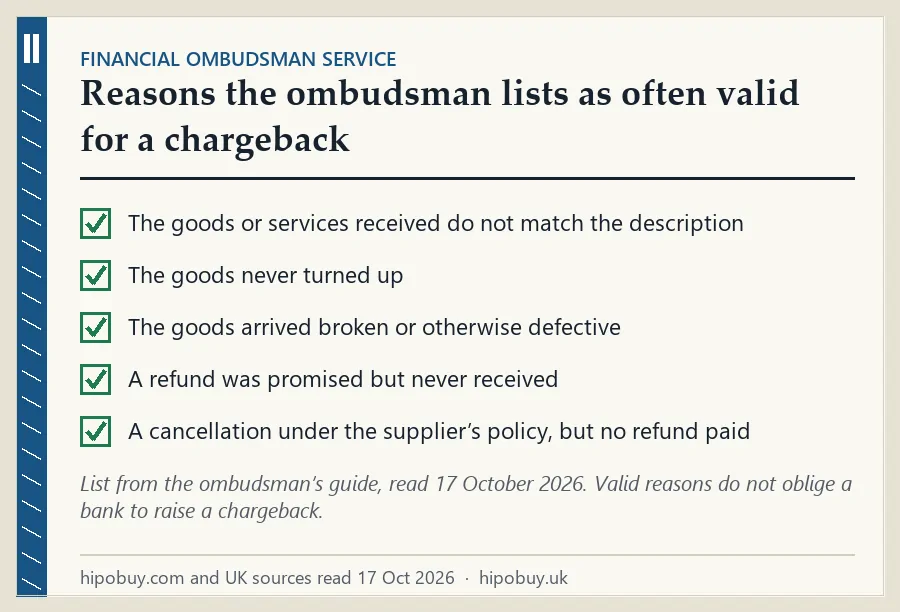
The reasons the ombudsman lists as often valid are in the figure. They are written for any purchase; this site does not map them onto Hipobuy orders.
Time limit
Around 120 days, and the date it counts from
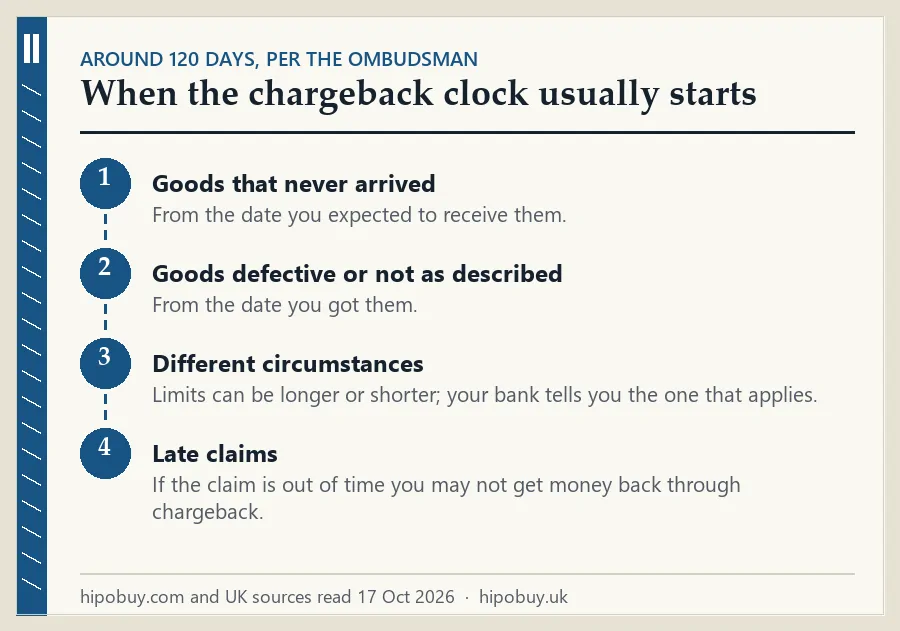
The ombudsman says you usually have “around 120 days” to raise a chargeback about goods or services. The start point moves with the problem: the date you expected goods that never came, or the date you received something defective or not as described.
It also says limits can be longer or shorter depending on circumstances, and urges you to follow problems up promptly and ask your bank or lender which limit applies.
At an agent like Hipobuy, an order’s dates are spread out: payment, purchase from the seller, arrival at the warehouse, dispatch and delivery can sit weeks apart. Which of those your bank treats as the expected date is a question for the bank. This site does not work out dates for you.
Statute
Section 75 in the Act’s own words
The section itself, in the 1974 Consumer Credit Act, is short. Its first subsection says that where a debtor under a debtor-creditor-supplier agreement has a claim against the supplier for misrepresentation or breach of contract, they have “a like claim against the creditor”, and the two are jointly and severally liable.
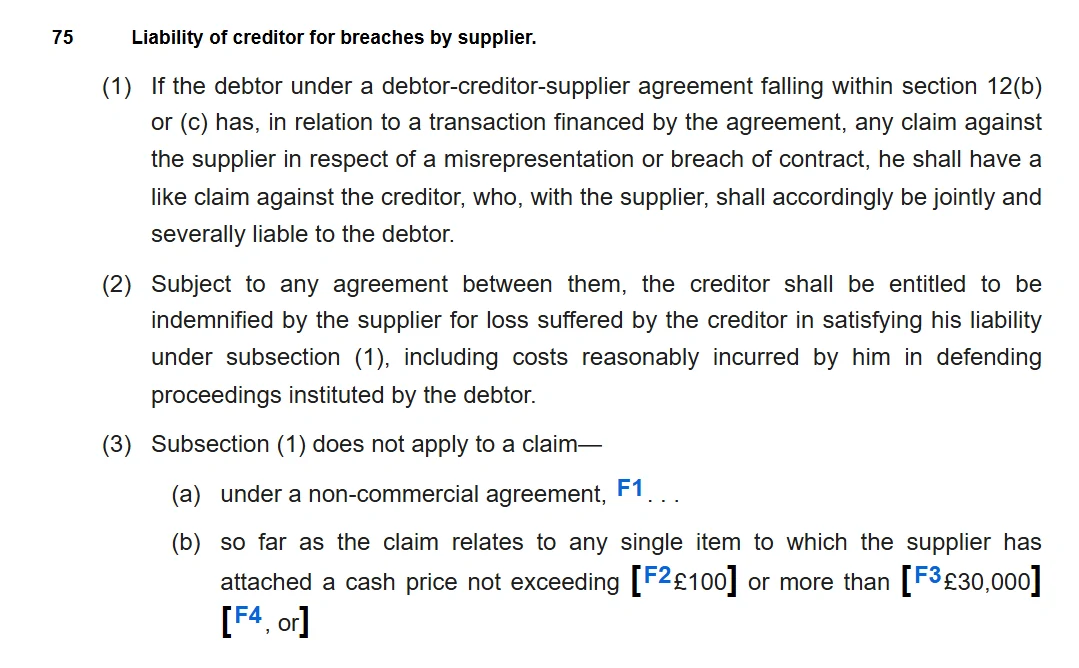
Subsection 3 sets the limits: the section does not apply to a single item whose cash price is not more than £100 or more than £30,000. The text on legislation.gov.uk shows these figures inside brackets because they were inserted by later amendment; the full version notes the changes. For prices above £30,000 the ombudsman points to section 75A, a separate provision.
When the ombudsman says Section 75 applies
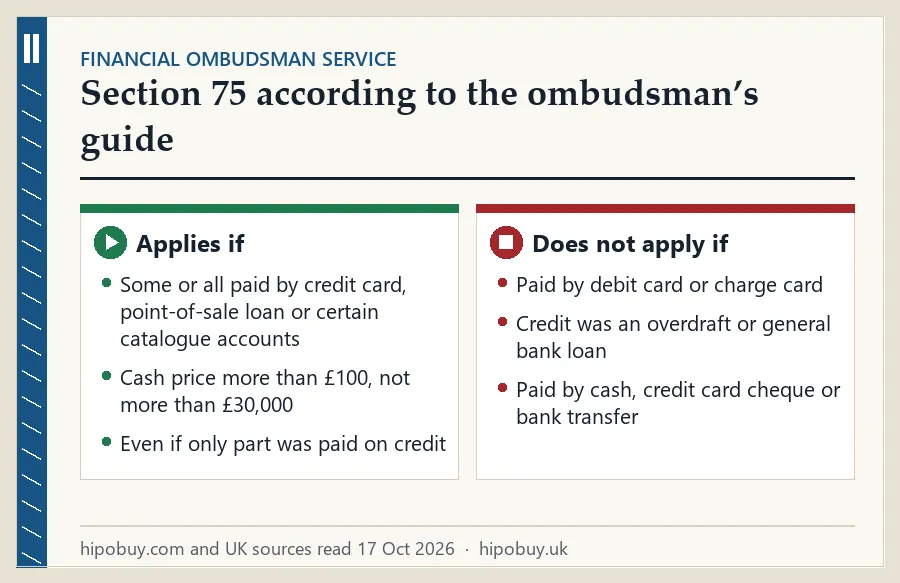
The ombudsman turns the Act into plain conditions. Section 75 applies if you paid some or all of the cost by credit card, point-of-sale loan or certain catalogue accounts, and the cash price is more than £100 but not more than £30,000.
It stresses that the cash price is what counts, not the amount on the card, so a part payment on a credit card can still be covered. It also lists where Section 75 does not apply: debit cards and charge cards, overdrafts and general bank loans, cash, credit card cheques and bank transfers. For debit cards, it says the card provider may still help through chargeback.
Then comes the condition that decides most hard cases. There must be a clear agreement between you, the supplier and the lender, the debtor-creditor-supplier link, and the ombudsman says whether it is in place “isn’t always straightforward”.
The three-party link and an agent wallet
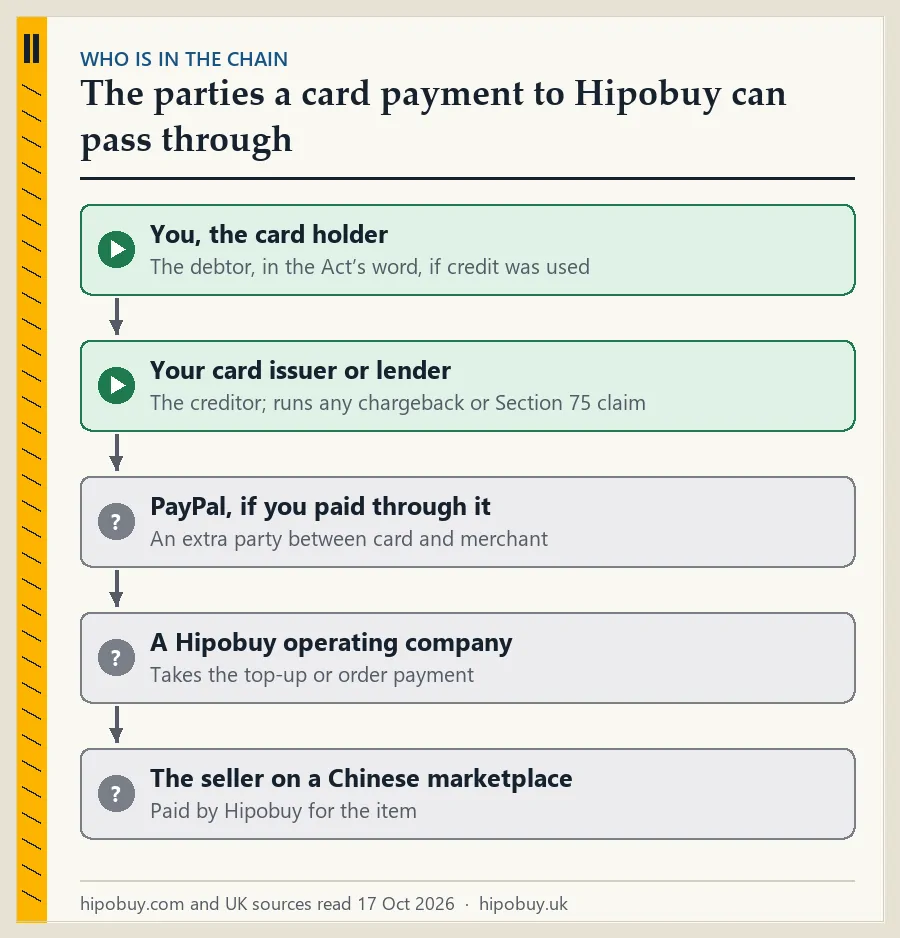
The ombudsman’s guide says “how you made your purchase, and the parties involved, might impact your Section 75 claim”. With an agent, more parties are involved than in an ordinary online shop.
Your card pays a Hipobuy operating company, sometimes through PayPal. That company holds the money as wallet balance or spends it on an order. Hipobuy then pays the marketplace seller, who supplies the item. A top-up buys balance; an order buys an item through an agent.
Where, if anywhere, the debtor-creditor-supplier link holds in that chain is not something the ombudsman’s general guide answers, and not something this site will answer for you. The guide says your bank or lender should be able to help, and that you can complain if you are unhappy with how they looked at it.
It helps to know which company appears on your statement. Hipobuy lists five joint operators, and the name your bank shows for the payment is the supplier as far as your bank is concerned. Keep that statement line with the rest of your papers.
What to have ready, and where a complaint goes next
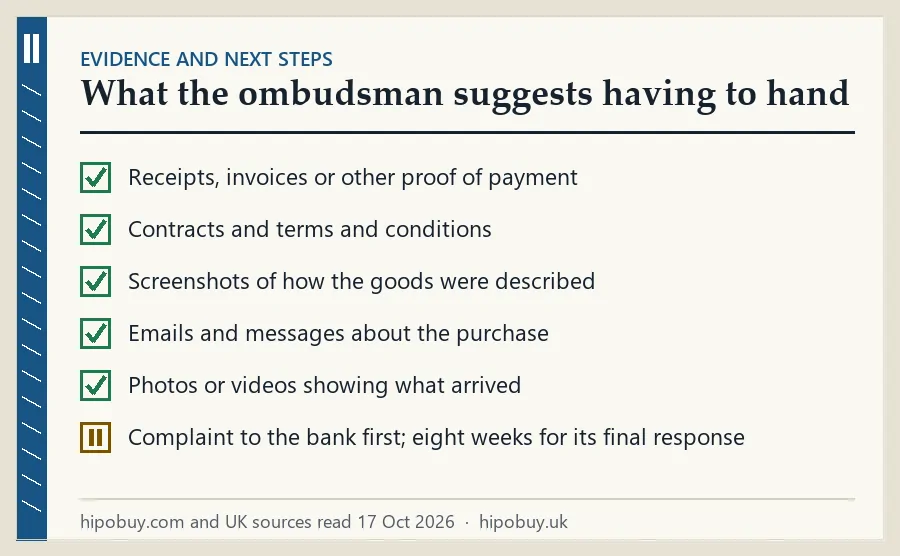
When you contact your bank or lender, the ombudsman suggests explaining what you paid for, asking it to consider chargeback and Section 75, and having supporting information ready: receipts or proof of payment, terms and conditions, screenshots of how the goods were described, correspondence, and photos or videos of what arrived.
For a Hipobuy order, the Hipobuy side of that file is already familiar: the saved listing, the QC photos, the order status history, the Service Terms page and any written replies from customer service.
If the bank’s answer does not satisfy you, the next step is a formal complaint to the bank. If it sends no final response within eight weeks, or you disagree with it, the ombudsman says you can bring the complaint to it, free of charge. Before any of this, remember what a chargeback triggers at Hipobuy, set out on the lock page.
Read the primary sources
Financial Ombudsman: chargeback and Section 75 · Consumer Credit Act, section 75
Official provider guidance checked again on 18 October 2026. The provider or lender must assess how its rules apply to your particular transaction.